


Diagnostic Evaluation
Complements SPEP and IFE during assessment of suspected plasma cell disorders.
For in vitro diagnostic use.

Multiple myeloma (MM) is a clonal plasma cell malignancy in which abnormal plasma cells produce monoclonal immunoglobulins and/or excess kappa or lambda light chains (FLC).1 Since clinical presentations are often nonspecific, laboratory evaluation of monoclonal proteins plays a central role in diagnosis and patient management.
Diagnosing and managing multiple myeloma requires more than identifying the presence of monoclonal protein.1 While Serum Protein Electrophoresis (SPEP) and Immunofixation Electrophoresis (IFE) remain important components of diagnostic testing, clinicians often need additional information to help characterize the disease, establish baseline measurements and monitor changes over time.
Recognized by the International Myeloma Working Group (IMWG), serum free light chain testing provides quantitative measurement of circulating kappa and lambda free light chains (KLFLC),2,3 complementing traditional testing approaches and supporting a more comprehensive assessment of patients with multiple myeloma.4
Click here for the full INTENDED USE AND IMPORTANT SAFETY INFORMATION for KLFLC.
 Source: Bhutani et al.
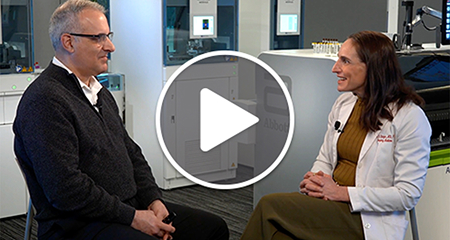
Hear from laboratory and clinical experts on multiple myeloma testing strategies, the role of free light chain testing for multiple myeloma diagnosis and management, and considerations for implementing KLFLC testing in your laboratory.
The Diazyme KLFLC assays on the Alinity c system can accurately detect unbound light chains, enhancing diagnosis and ongoing disease management of multiple myeloma in conjunction with other laboratory and clinical findings.2 From initial suspicion through long-term follow up, KLFLC testing helps inform patient management with highly sensitive, quantitative results.4
Complements SPEP and IFE during assessment of suspected plasma cell disorders.

Provides quantitative measurements that help support ongoing patient monitoring.

Tracks changes in Kappa and Lambda FLC concentrations throughout therapy.

Supports longitudinal evaluation as patient status evolves.
Traditional FLC testing often requires standalone systems, dedicated open-channel workflows or send-outs — adding variability, cost and operational complexity. With KLFLC assays integrated directly onto Alinity c, you can support both operational efficiency and clinical decision-making to help deliver consistent, reliable patient care.5





| Multiple Myeloma |
| Diazyme Human Kappa (κ) Free Light Chain |
| Diazyme Human Lambda (λ) Free Light Chain |

Compact clinical chemistry system maximizes testing throughput with high-quality assays to deliver efficient and accurate performance.

Login or register for a new account on the Lab Central customer portal. Here you can view assay-specific package inserts for intended use and important safety information, and you can manage your personalized lab metrics.
Gain a deeper understanding of multiple myeloma as a disease, how FLCs can aid in diagnosis and monitoring of MM.
| Publication | Description |
| Advancing Diagnostics: Kappa and Lambda FLC Assays for Early Detection and Rigorous Monitoring of Multiple Myeloma | This whitepaper highlights Kappa and Lambda FLC assays enable earlier detection and monitoring of multiple myeloma with performance comparable to established FLC testing methods.6 |
| International Myeloma Working Group Updated Criteria for the Diagnosis of Multiple Myeloma | This consensus paper establishes updated diagnostic criteria for multiple myeloma, combining CRAB features with validated biomarkers.7 |
| Multiple Myeloma for the Primary Care Provider: A Practical Review to Promote Earlier Diagnosis Among Diverse Populations | This publication offers guidance for clinicians to identify multiple myeloma sooner and reduce delays in diagnosis, especially in diverse patient populations.1 |
| Inter-Assay Variability in Automated Serum Free Light Chain Assays and Their Use in the Clinical Laboratory | This publication highlights the need for consistent KLFLC testing methods when diagnosing and monitoring patients.2 |
The Diazyme Human Kappa (𝜅) Free Light Chain Assay and The Diazyme Human Lambda (ƛ) Free Light Chain Assay are intended as latex particle enhanced immunoturbidimetric assays for the quantitative determination of Kappa and Lambda FLC concentrations respectively in serum on validated analyzers. The measurement of Kappa FLC in conjunction with Lambda FLC aids in the diagnosis and monitoring of multiple myeloma in conjunction with other laboratory and clinical findings. For in vitro diagnostic use only.
Important Safety Information
Prescription use only. For professional use only.
Caution: Federal law restricts this device to sale by or on the order of a physician or other practitioner licensed by laws of the State in which he/she practices, to use or order the use of the device.
Specimens containing human sourced materials should be handled as if potentially infectious using safe laboratory procedures, such as those outlined in Biosafety in Microbiological and Biomedical Laboratories. The reagent contains sodium azide as a preservative. Sodium azide may react with lead and copper to form highly explosive metal azide. On disposal, flush with a large volume of water to prevent azide buildup.

Abbott's high-quality immunoassay menu helps laboratories meet requirements to be reliable, accurate and precise.

Learn about Abbott's biomarkers for ovarian cancer focusing on CA 125 and HE4 for early detection and monitoring.

Discover how Alinity uses powerful technology to help redefine and improve operational productivity and confidence in your laboratory.
Links which take you out of Abbott worldwide websites are not under the control of Abbott, and Abbott is not responsible for the contents of any such site or any further links from such site. Abbott is providing these links to you only as a convenience, and the inclusion of any link does not imply endorsement of the linked site by Abbott. The website that you have requested also may not be optimised for your screen size.
Please be aware that the website you have requested is intended for the residents of a particular country or countries, as noted on that site. As a result, the site may contain information on pharmaceuticals, medical devices and other products or uses of those products that are not approved in other countries or regions.