



Whitney Welker (05:38):
I feel like the lab's worst nightmare is LIS
(14:46):
Downtime.
Whitney Welker (05:42):
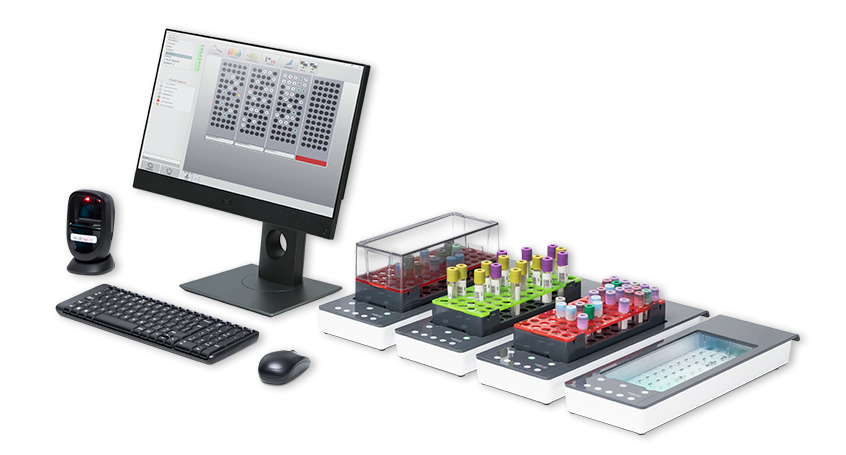
with AlinIQ AMS, we are able to order patients in AMS, and this will print off barcodes so we don't have to manually type in those patient names on the instrument, what test...
Whitney Welker (05:54):
all we do is slap on that barcode on the patient sample, put on the instrument, the information will transfer into AlinIQ AMS. So when our LIS system is back up, we're able to transport that data into the LIS.
Whitney Welker (01:24):
I feel like middleware is the heart of the lab.
Whitney Welker (05:45):
As of right now,
Whitney Welker (06:23):
We have two ci modules, and one standalone c module, along with our Alinity m that is connected to our AlinIQ AMS.
Whitney Welker (08:06)
The implementation process for AlinIQ AMS, from a lab standpoint, was very ease. Abbott has a lot of these pre-built rules library they were able to utilize.
Whitney Welker (03:47):
The capability of AMS alone is mind-blowing.
Whitney Welker (09:21):
The auto-verification rules really help to improve our turnaround times. And with that, the clinicians are able to get the results faster, and our techs are able to spend more time
(09:05):
to deep dive into specimen issues that they have for other patients.
Whitney Welker (18:56):
The impact that AlinIQ AMS and the GLP have had on our turnaround time, is an overall decrease in our turnaround times by 27%.
Whitney Welker (20:45):
I track my STATs on a monthly basis. We would like 95% of our STATs completed within 45 minutes or less.
Whitney Welker (20:53):
Before AMS and the GLP Track system, we were meeting that goal 40% of the time. And that first month of having AMS and the GLP Track system, we were able to improve by 40%. And so now our overall turnaround time is, we're meeting that goal by 80%.
Whitney Welker (14:31)
I feel like QC mapping, for me, is much easier with AMS, than it was with past middleware. I’m able to navigate the system much easier, my techs are able to navigate it much easier.
Whitney Welker (11:27):
Some of the pain points that I had with other middleware in the past,
Whitney (13:12):
was service.
Whitney Welker (11:37):
If I had a problem on a Friday, they'd be like, "Oh, I'll call you back later today," and I wouldn't get a call back until Monday, or I had to reach back out to them.
Whitney Welker (13:29):
But with Abbott and AlinIQ AMS service, I am able to get somebody on the phone right away. And then communication continues through email.
Whitney Welker (11:59):
I can't spend all day on the phone, so I love that email communication that AMS and Abbott support for me.
Whitney Welker (04:31):
I would say change is hard in the laboratory, especially for techs.
Whitney Welker (29:06):
I went out on maternity leave when this lab went live with AMS.
Whitney Welker (03:45):
When I returned back 12 weeks later, my not-so-tech-savvy techs
Whitney Welker (04:42):
were so used to it and it was so easy to use that they were able to teach me as their lab manager how to use that system when I returned.
Whitney Welker (29:19):
Which I thought was amazing.
Whitney Welker (17:24):
Working in a laboratory, we want to give out great results to the clinicians, to improve patient care. And with the GLP and the AlinIQ AMS, we are able to reduce our turnaround times, to get those results out faster. And we know for sure that those are good results.
Abbott sonic logo